MarketWatch reported this week that 8% mortgage rates are not an impossibility as the 30-year fixed surges. The national 30-year average now sits at 7.03% as of September 24, up from 6.95% the week before and 6.30% a year ago, according to Freddie Mac, which is what put 8% back in the conversation. Rather than react to a national headline, here is what an 8% rate would actually do to the Colorado Springs market, in local numbers.
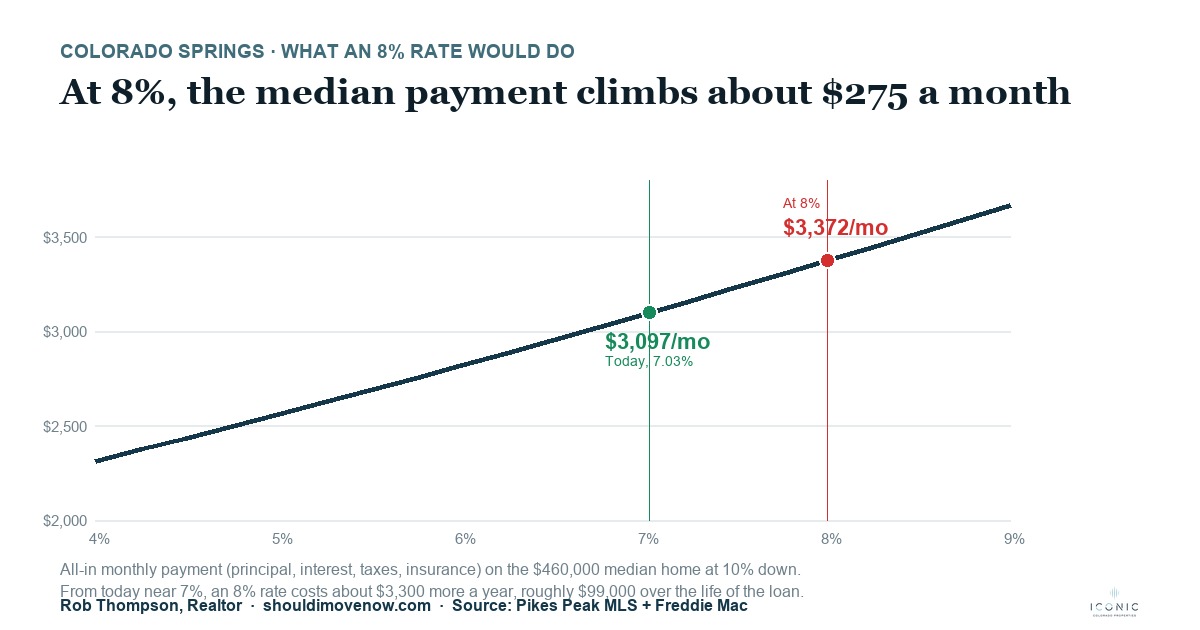
The median home that closed in the Pikes Peak region over the past year sold for about $460,000. At today's rate of 7.03%, the all-in monthly payment (principal, interest, taxes, and insurance, with 10% down) runs about $3,097. At 8%, the same house costs about $3,372 a month.
That is about $275 more every month, roughly $3,300 a year, and close to $99,000 in extra interest over the life of a 30-year loan. And remember, we have already made most of this climb: a year ago the 30-year averaged 6.30%, so the payment on that same home has already risen with the run-up to 7%. The last leg to 8% is what remains. Nothing about the house changes. Only the rate does.
Payment-to-income is the honest measure of whether a market can clear. On the median home it is already stretched: today's payment takes about 40.9% of the median local household income of $90,778. At 8%, that climbs to about 44.6%. Lenders generally look for housing costs at or under 28% to 36% of gross income, so the median home already sits above that band, and 8% pushes it further past it.
Said another way, to qualify for the median home at a 36% front-end ratio you would need about $103,200 in income today. At 8% you would need about $112,400. The typical Colorado Springs household earns about $90,800, which means the median buyer is already below the line at current rates, and 8% moves that line further out of reach.
When rates rise, one of three things has to absorb the shock: incomes rise, prices fall, or the number of sales falls. Incomes do not jump double digits in a year. For prices alone to absorb an 8% rate and hold the monthly payment where it is today, the median would have to fall about 9%, to roughly $420,700.
Locally, the most likely release valve is the third one: fewer transactions. Most owners here hold mortgages well below today's rates and will not trade a sub-4% loan for an 8% one, so they stay put. That keeps inventory thin and props up prices even as demand weakens, which is why higher rates tend to freeze a market more than crash it. Our sales velocity data shows the pattern: as payments have outrun incomes, the number of homes changing hands has fallen back toward levels last seen in the 1990s, even though the population is larger than ever. An 8% rate would deepen that freeze rather than trigger a fire sale.
This part is not guesswork. We have already watched these three numbers respond as rates climbed from under 3% in 2020 and 2021 to the mid 6s today. Each leg up did the same three things: it thinned the number of sales, stretched how long homes sat, and pulled the closing price further below the original asking price.
| Year | Avg rate | Homes sold | Median days on market | Close to original list |
|---|---|---|---|---|
| 2020 | 3.1% | 19,258 | 4 | 100.0% |
| 2021 | 3.0% | 16,544 | 4 | 101.9% |
| 2022 | 5.3% | 12,510 | 5 | 100.0% |
| 2023 | 6.8% | 13,463 | 16 | 100.0% |
| 2024 | 6.7% | 13,141 | 24 | 98.8% |
| 2025 | 6.6% | 13,346 | 31 | 97.8% |
Pikes Peak MLS residential closings. Through the first part of 2026, at roughly 6.4%, the median home takes about 29 days and closes near 97.9% of its original list price.
The shape is clear. Annual sales fell from about 19,000 at the 2020 low-rate peak to roughly 13,000 by 2025, close to a 30% drop. Median days on market went from about four days to about a month. And the median home went from selling at or above its original asking price to closing near 2% below it, which means sellers are now the ones giving ground.
An 8% rate would push all three further in the same direction: fewer buyers who can qualify means still lower volume, homes sitting well past a month, and more sellers accepting offers below their original list, often with a concession on top. The relationship is not a straight line, because lock-in keeps many owners off the market and cushions prices, but the pressure then shows up in time and negotiation instead of a sticker crash. In plain terms, at 8% you should expect a slower market where the buyers who remain hold more of the leverage.
You can refinance a rate. You can never refinance a price. If you buy at 8% and rates later fall, you reset the payment. If you wait and prices rise, that higher basis is permanent. The two levers that actually move the monthly number at 8% are a larger down payment and a seller-paid rate buydown, and both exist in this market right now. We track live seller buydowns, assumable loans, and owner financing as sellers use them to bridge the gap.
At 8%, your buyer pool narrows to households that can carry a payment near 45% of income or bring more cash to the table. Pricing correctly the first time matters more than ever, and offering a rate buydown often does more for your buyer than a price cut of the same size. Our seller readiness tool and the live concessions tracker show what is actually clearing in your price band today.
This is not a forecast that rates will hit 8%. It is what the local math says would happen if they did: about $275 more a month on the median home on top of the run-up we have already had, a median buyer already priced out on paper, and a market more likely to slow than to break. The number to watch is not the rate on the news. It is your own payment-to-income, and whether the home you are considering still pencils at the rate you can actually get.
Methodology: payment figures use the median closed price for the Pikes Peak region over the trailing twelve months, 10% down, an approximate El Paso County effective tax rate, and $1,800 a year in insurance. Today's rate is the Freddie Mac 30-year average of 7.03% for the week of September 24, 2026. Income is the most recent median household figure. These are planning estimates, not quotes. Analysis by Rob Thompson, Realtor, Iconic Colorado Properties. Sources: Pikes Peak MLS closed sales, Freddie Mac, U.S. Census ACS.
Have questions about the market?
Get personalized guidance from Rob Thompson.
Get daily email alerts when new homes matching your criteria hit the market.
Create a free account to save listings and get notified when new homes match your criteria.
No spam, just houses.
Get an accurate homeowner's insurance estimate from Patrick Murakami at Main Street Insurance - no obligation.
Get connected with a trusted local lender for pre-approval, rate quotes, or financing questions - no obligation.