Everyone agrees Colorado Springs home prices took off. The usual explanations are a housing shortage and a wave of demand. Our data points somewhere else, and it shows up in a single chart: the median sale price tracked the U.S. money supply almost exactly.
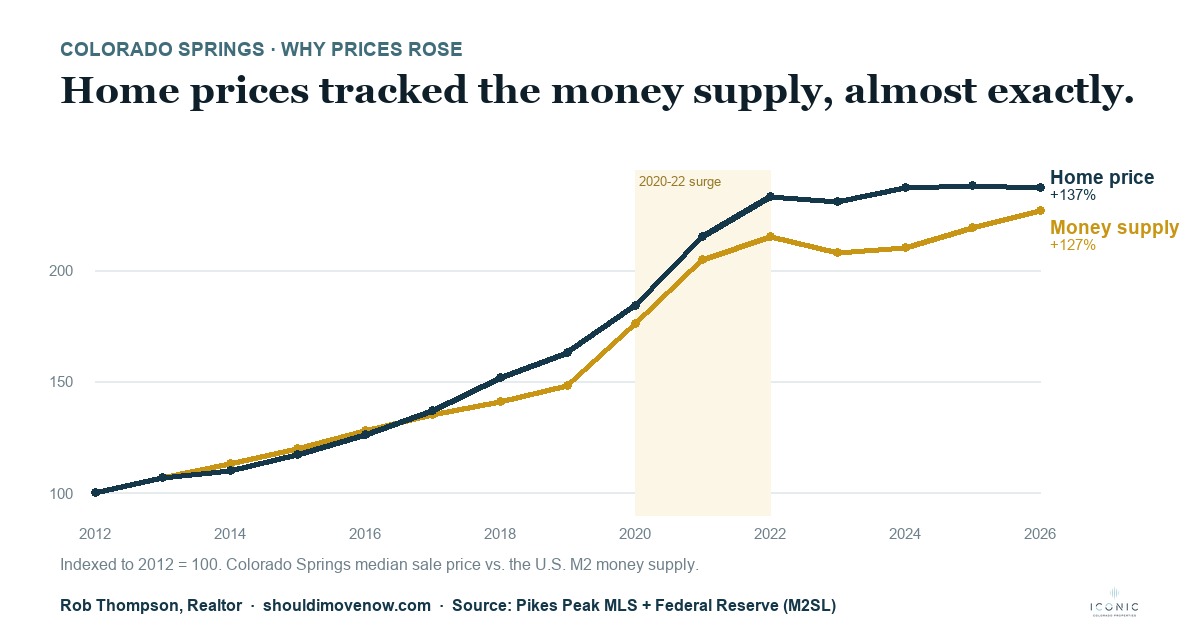
Indexed to 2012, the local median price rose about 137% and the M2 money supply rose about 127% over the same fourteen years. Two lines, moving together, through a decade and a pandemic. That is not what a supply-and-demand story looks like. It is what a money story looks like.
The sharpest run-up was not spread across the six years. It was concentrated in about two: the median went from $317,000 in 2019 to $455,000 by 2022. That is exactly when M2 exploded, from $14.8 trillion in 2019 to $20.6 trillion in 2021, a 39% increase in two years against a normal pace closer to 6% a year. At the same time the average 30-year mortgage rate fell below 3%. More money, and nearly free to borrow, chasing a housing stock that cannot grow that fast. Prices did what prices do when that happens.
Here is the part a shortage cannot explain. When the Federal Reserve stopped expanding the money supply and rates climbed back to the mid-6s, the price line went flat. The median was $455,000 in 2022 and about $463,000 in 2026, up roughly 2% in four years. A real, physical shortage does not resolve itself the instant the Fed changes policy. A repricing driven by money and rates does exactly that. The flattening is the fingerprint.
If this were sustained organic demand, sales volume would have stayed high. It did not. Closings peaked near 19,300 in 2020 and fell to about 12,500 by 2022, sitting near 13,000 since. Volume collapsed by a third while prices held. That combination, high prices and dead volume, is a frozen market, not a booming one: rate-locked owners will not sell into it, so few homes trade and the ones that do hold their number. Scarcity of *sellers*, created by rates, not a scarcity of houses.
It is tempting to list price and rates as two different problems. They are two acts of one monetary story. In act one, cheap and abundant money inflated the price. In act two, expensive money froze the price and sent the monthly payment up about 75% while incomes rose only 25% (see the five-year affordability breakdown). Same cause, opposite effects, four years apart.
If the price is largely a monetary artifact and the squeeze is largely the rate, then the two move on different clocks. The price you agree to today is permanent. The rate is not; it can be refinanced if it falls. That is the practical reason we keep saying refinance the rate, never the price. It also means the widely predicted price crash has not come, because the thing that inflated prices, the money, has not been withdrawn. M2 never gave back the 2020 to 2021 surge; it flattened and then resumed a slow climb. Flat prices, not falling ones, are what that produces.
M2 is a national figure and the price here is local, so this is a strong relationship, not a controlled proof. Real local factors did contribute: Colorado Springs underbuilt for years and drew steady in-migration. But neither of those turned on in 2020 and off in 2022, and neither explains why the price line flattened the moment monetary policy reversed. The timing is what points at money. Read this alongside supply versus affordability, market velocity, and buy now or wait.
Analysis by Rob Thompson, Realtor, Iconic Colorado Properties. Sources: Pikes Peak MLS (elevateMLS) closed residential sales; Federal Reserve M2 money supply (M2SL). Both series indexed to 2012.
Have questions about the market?
Get personalized guidance from Rob Thompson.
Get daily email alerts when new homes matching your criteria hit the market.
Create a free account to save listings and get notified when new homes match your criteria.
No spam, just houses.
Get an accurate homeowner's insurance estimate from Patrick Murakami at Main Street Insurance - no obligation.
Get connected with a trusted local lender for pre-approval, rate quotes, or financing questions - no obligation.